Personal happiness and political life
American WomanPersonal happiness and political life are not separate subjects for Jenny: the novel makes her capacity to want comfort, intimacy, and a future part of her changing understanding of political commitment. Revolutionary work once demanded physical readiness, ideological certainty, and the subordination of private desire; later, gardening, shared learning, and choosing a room become ways to reconsider what a struggle for change is for. The possibility of happiness remains vulnerable, however, to political violence and to the unequal judgments that follow it.
Revolutionary Life and Its Limits
In the underground group, politics reaches into bodies, loyalties, and everyday conversation. After the deaths of comrades, Jenny overhears Yvonne challenge Pauline over the group’s failed cover: Yvonne insists that Pauline cannot blame Juan alone when she herself had been too slow. Pauline cries that she is sad, while Yvonne shifts from an accusatory voice to a reassuring, almost maternal one. The scene gives political responsibility an intimate scale: grief and blame coexist, and even consolation takes place within a group shaped by danger and loss.
The same tension appears when Juan invites Jenny to join a war game with Pauline. Jenny dislikes such games, but Juan argues that the revolution needs her body to be strong. Political commitment is thus framed not only as belief but as training and bodily usefulness. Pauline’s tense response, which Jenny watches more closely than Juan does, complicates the invitation: a group’s plans and demands affect its members differently, and Jenny senses distress that the organizer addressing her does not attend to.
As Jenny becomes less securely included in the group, she recognizes the difference between being offered a place and sharing its intimacy. When Pauline temporarily loses her hearing, Juan and Yvonne exchange notes with her and turn the episode into a game of private communication. Jenny is not openly barred from joining, but she feels neither fully part of the group nor completely outside it. The experience recalls Pauline’s earlier in-between status as a captive who was not yet a comrade. For Jenny, the group’s unity is real, but it can also leave one person without a voice in the shared exchange.
Women’s Knowledge and Political Change
The group’s attempt to write a book reveals another limit in its political practice. Its members cannot make an opening claim without tracing and proving every premise: a discussion of U.S. intervention in Vietnam widens into debate over French colonialism, the postwar rearrangement of borders, and the rise of the nation-state. Their pursuit of a fully grounded account consumes attention that might have gone to the present. Jenny’s observation is not that historical context is irrelevant, but that exhaustive argument can become a way of postponing action.
Later, a women’s firearms group offers a different model of political learning. Pauline wants to teach other women what she learned with the revolutionary group, not so they can harm people but so they can understand firearms and the ways men use and misuse them. Jenny joins Sandy, Sandy’s younger sister Joanne, and Joanne’s housemate Lena in learning about parts, ballistics, and the uses of different guns. They dismantle and clean a 12-gauge shotgun with pipe cleaners and household rags. The practical lesson is also an intellectual and social one: the women can ask questions, make lists, and learn without pretending they already know.
Their discussions identify how routinely women have presented themselves as more knowledgeable than they feel, privately catching up while performing confidence. Jenny connects that pressure to the transformation she once experienced in loving William: becoming the person a lover desired could feel exhilarating, but it also rested on a divided self. The women contrast this performance with a male culture of presumed knowledge, in which reading, sexual experience, or even being lost while driving is treated as something one must already have mastered. Learning together makes room for uncertainty and wonder rather than turning ignorance into a source of shame.
This feminist understanding also changes how Jenny and Pauline interpret revolutionary history. Their group recognizes that women have often followed men, including in movements whose celebrated women were subordinated to more revered male figures. Pauline argues that women must take leadership roles and sees the armed abduction that made her a captive as an expression of masculine violence, even when the men involved claim political purpose. Jenny resists explaining men’s methods as inevitable consequences of being men, comparing that logic to the claim that housework is women’s nature. Their disagreement preserves an important distinction: shared opposition to women’s subordination does not require a single account of how gender shapes political action.
Domestic Happiness as a Political Question
The women’s later life gives this debate ordinary, material form. By August, their garden produces enough vegetables for grocery bags to be given to Tom Milner, Sandy, Mike Sorsa, Mr. Minski, Joanne, and Lena. When the first zucchini is ready, Jenny and Pauline spend a day preparing a meal of ratatouille, salad, homemade bread, and cake, with wine. Flowers, a thrift-store cloth, a meal made for themselves, and vegetables shared with friends are not treated as proof that politics has ended. Instead, they prompt the question of whether comfort is necessarily bourgeois, selfish, or politically suspect.
Jenny and Pauline work that question into a long letter to William, which Pauline reads and edits. Their collaboration matters: the letter begins as Jenny’s correspondence but becomes a piece they have composed together, not yet sent. Pauline asks whether it is really wrong to want happiness. The question gathers force because both women have learned to regard personal pleasure with suspicion, as if wanting a good life were a betrayal of those who suffer or of the cause that once organized their lives.
The calm of the house is not presented as secure. Jenny and Pauline’s senses, once sharpened by the quietness of life on the farm, have softened into a serenity that lets them attend to domestic details without treating every silence as danger. Then an armed man appears at the open Dutch door, and Jenny’s body rises before her mind has accepted what is happening. The interruption exposes the limits of private refuge: a life made more peaceful by changed values can still be overtaken by the unresolved consequences of political violence.
Punishment, Privilege, and Unequal Restoration
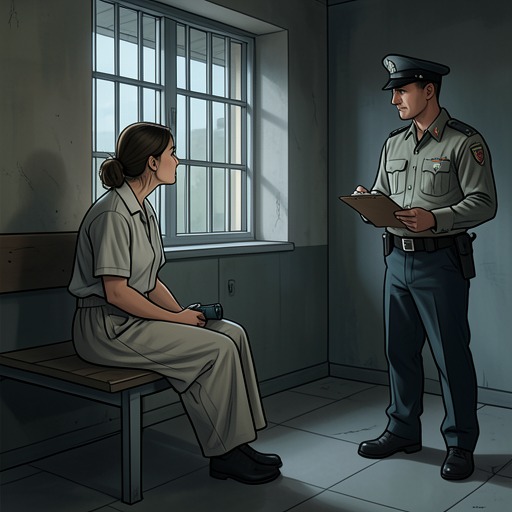
The legal outcomes further complicate the idea that suffering or punishment settles a person’s relation to politics. Jenny and Pauline are tried, convicted, and sentenced for acts committed before they met; their later life together is not inscribed in the charges. Pauline is convicted of the bank robbery and serves less than two years before her sentence is commuted. Though the press presents her as having received a severe sentence, she emerges with her class privilege largely intact, treated as someone who has undergone an adventure rather than someone permanently degraded by prison.
Jenny receives the minimum sentence for her participation in the selective-service recruitment-center bombings. After a year, good behavior earns her transfer to a work-release program. Yet what appears to be leniency produces shame rather than uncomplicated relief. Being given pleasant kitchen tasks and praised for behaving well makes her feel newly marked as an exception: the model minority rewarded as better than the group to which she belongs. The difference between Jenny and Pauline is therefore not reducible to the charges or formal punishments. Class and race shape what punishment means, what kind of redemption is available, and whose suffering is understood as temporary.
Choosing a Future
Two years later, back in Berkeley, Jenny is surprised to miss the East Coast while still associating it with a former self who wanted irresponsible freedom. She recognizes that politics has sometimes served as her justification for wrong turns and lost time, even as it makes her own desires harder to justify. Wanting a pleasant room is one such desire, and she is afraid she does not deserve it. Her hesitation shows that the end of underground activity has not instantly freed her from the habits of self-denial it cultivated.
When Jenny answers an advertisement for a housemate, the room she chooses is not the proper bedroom but a three-sided dining-room nook with a large bay window. From it she can see rosemary in the yard and, beyond it, a lime tree. The bedroom upstairs has four walls and a door, but lies beneath the eaves and looks onto a neighboring roof. Jenny’s preference for the brighter space marks a modest but distinct return of wanting: the choice is not grand, but it belongs to her.
The housemates, younger graduate students and other seekers, vote to invite her to live in the nook and plan to make a partition. Their communal practices—sharing a house, buying staples in brown paper bags, and tending compost—belong to a changed political world, not the underground one Jenny knew. At twenty-nine, she feels close to completing a transition and begins to imagine having a child, not through romance or marriage but as a person capable of accompanying a child. She treats the present as preparation rather than a final destination. In that open-ended future, happiness is no longer simply a distraction from political life: it is a desire Jenny is learning to permit, without knowing exactly what form it will take.